I sat tensely. All 43 of the muscles in my face were on the brink of contracting. My only solace was the mashup composed of the monotone buzz of the tattooing needle and the harmonized mix of today's pop with the low humming of my artist Lou, whose only goal in life—yeah, you guessed it—was to tattoo. I watched silently as the shading needle pierced my skin. I squinted slightly to see if I could still see the characters '', '', '' through the smudge of black ink, lubricant, and blood. I could, but only just.
The characters were part of a mathematical equation that wrapped my right forearm just below the elbow. I had always struggled in mathematics but, several years earlier, the University of Nebraska had granted me a conditional acceptance provided I successfully completed three remedial math courses. It was ironic to me that I would be covering a math tattoo at all. I will die still regretting that decision. Not because people would occasionally stop me to ask what it was, what it meant, or why I would have a tattoo like that. It wasn't exactly getting me in the door to any biker bars either. No. It's that it represented so much more to me than I knew.
First, we've got to travel back a few years. I had passed the first two of the three remedial mathematics courses and had received top grades in both. As such, UNL had granted my application fully, stating, "You'll just take the last one here." In addition to granting my admission, they allowed me to redeclare my major from Professional Golf Management to Computer Engineering. I was set. After taking trigonometry, pre-calculus, and differential calculus, no amount of mathematics would satisfy me. The rules are quite simple. Something is said to be true, or it is said to be not true (false). My fascination extended beyond the classroom. I frequented the university and local bookstores looking for books about more math. As I browsed the pages of one of the books, I stopped on some random page. My eyes landed on the first section title of the page. It read "Paradoxes of Motion."
The section was an excerpt regarding the Greek philosopher Zeno of Elea. As I read the section, I felt a sudden unease. Albeit usually framed as Achilles and the Tortoise, the famous paradox posits the idea that I could not, mathematically speaking, leave the room that I was currently occupying. Obviously this was absurd. I was standing in the bookstore. I had obviously left my home to get to the bookstore, so my ability to exit a space was evident. What was the catch? What was I missing?
I thought about the idea again and again. At that point, I had not yet formally been introduced to infinite sequences and series nor had I given any thought to the idea that it might be possible to add an infinite quantity yet produce a finite result. A quick web search was more than adequate to find almost anything I wanted to know as Zeno's paradox is quite famous. I just didn't have the mathematical maturity to parse the symbols and notation. There was nothing for it. It seemed like magic. What I needed was to convince myself.
I began to work through it. It was clear to me that to leave the room I was standing in, I must first traverse half of the distance between myself and the door. It was also clear that from the midpoint of my starting position to the destination, I would again need to travel half of the distance. Considering the unit distance,
where is some natural number.
It is perfectly reasonable. Start with the entire distance being of unit length and consider its difference with the sum of the traversed sections. To convince myself, I needed to show that the limit of the series as approaches infinity was one. This would leave no doubt that I could reach the door. I considered the general statement
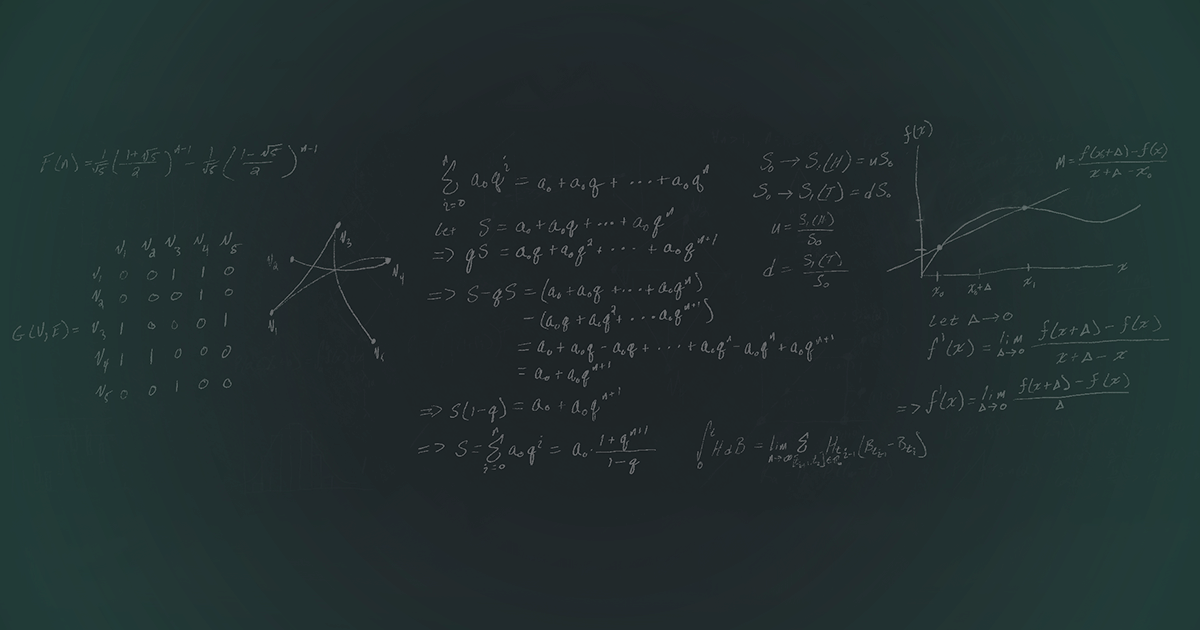
My education had shown me that it was unacceptable to use as a value. However, choosing some arbitrary natural number would be a perfectly adequate stand-in. With that, I determined Perfect! I had discovered, well, nothing really. Not only that, but my choice of an arbitrary had backfired as was missing from the equation entirely. How could be replaced? I would then discover that, if I scaled both sides by , I could resurrect my lost . Doing so, I determined that So considering would let me bring back into the fold. Great! But I still hadn't really achieved much of anything. That is, until I considered the difference of and . and it must be the case that simplifying the equation gave then algebraically As it happens, this is the closed form of the geometric series. I was out of my depth and still not entirely sure how this helped. It seemed logical to examine the behavior of for the value as the original experiment was to consider traveling half of the distance. Substituting implies Aha! no longer seemed cryptic to me. If I now considered what I knew, that being It was, using the most dangerous word in mathematics, "obvious" to me then that the exponential in the numerator would tend to zero as grew without bound. Then I stared at it for a while I was sure that the mathematics was sound. was simply some constant of proportionality. I could trivialize it by setting its value to the multiplicative identity. So and
This was unfortunate. I needed to show that as tended to infinity. What I had done was shown that . This was not ideal. Fortunately, I had listened very closely in Peder Thompson's Introduction to College Algebra and Trigonometry course the very first class I attended as a student at UNL. He continually implored me, and my twenty or so classmates, to always check that my result was reasonable. I began examining my work. Had I flipped a sign? Had I made an algebraic error?
I reconsidered After some time, I realized that I was indexing from zero. Having , would be . So as I considered large values of , the first term of the series was always one. This was not aligned properly for Zeno's dilemma. If the first term was one, and I had considered the unit distance, this meant I traveled the entire distance on the first try. Aha! To solve my problem exactly, I needed to subtract the initial term. So
I was now convinced. This infinite series would converge to a finite value. Well, sometimes. When I began this endeavor I was considering the size of the steps I would need to take over an infinite number of iterations. That size being half of the distance. As it happens, if I were to have chosen a step size larger than one— I could not choose one directly or my paper would burst into flames. The series fails to converge to a finite sum. A lesson for myself that even if the number of iterations seems infinite, taken in appropriately sized steps, I too would arrive.
Only a few years earlier, I was struggling to add fractions. The notations and symbols were all but out of reach. I would never possess the intellect required to grasp the subject. Yet, my curiosity, determination, and love of learning had led me to a place where I was willing to permanently embed them in my skin. This wasn't just a piece of mathematics. It was an ever-present reminder to myself that if I chose appropriately sized goals and had the stamina to persevere, the number of items in the series wasn't relevant. I had what it took, and I knew it.
It had been a tumultuous journey to that moment. Looking back, it wasn't just an equation being swallowed by blood, ink, and the waves of Lou's carefully crafted tattoo. It was a piece of me, a part of the identity I had built for myself. The tattoo remains, forever masked by the turbulent seas that would shape the next decade of my life.
Life, like mathematics, is a myriad of transformations. For me, so begins another.